My perspective to Bruce Nauman television art piece (at the Hamburger Bahnhof, Berlin, September 2010) becoming a David Lynchian experience.
Tuesday, 21 September 2010

Thursday, 16 September 2010
RIP: A Remix Manifesto - film screening and panel discussion

A screening of the fantastic RIP: A Remix Manifesto and followed up by a panel discussion with some leading technology and culture writers, presented by CoDE (as part of the Festival of Ideas):
Arts Picturehouse, Cambridge
October 30, Saturday, 15.00-17.30
Tickets from the Picturehouse ticket counter
"In RIP: A Remix Manifesto, Web activist and filmmaker Brett Gaylor explores issues of copyright in the information age, mashing up the media landscape of the 20th century and shattering the wall between users and producers.
The film’s central protagonist is Girl Talk, a mash-up musician topping the charts with his sample-based songs. But is Girl Talk a paragon of people power or the Pied Piper of piracy? Crea...tive Commons founder, Lawrence Lessig, Brazil’s Minister of Culture Gilberto Gil and pop culture critic Cory Doctorow are also along for the ride."
The screening is followed up by a panel discussion with
- Bill Thompson (technology writer and columnist for the BBC Online, as well as head of partnership development for Archive Development projects at the BBC)
- John Naughton (academic at Cambridge University, writer and columnist for the Observer),
- Becky Hogge (technology writer, columnist for the New Statesman and former executive director of the Open Rights Group),
- Jussi Parikka (media theorist and director of the CoDE-institute at Anglia Ruskin University)
and
- Geoff Gamlen (a founding member of the remix-music/video group Eclectic Method have been called upon by artists like Fatboy Slim & U2 and by film, video, and television companies such as New Line Cinema and Palm Pictures to create custom a/v remixes.)
The panelists address the themes raised by RIP: Remix Manifesto and a range of interesting and provocative approaches to cultural production in the digital age, copyright and its alternatives, and free culture.
Sunday, 12 September 2010
Recent books by friends
Some recent books by friends:
Michael G oddard: Gombrowicz, Polish Modernism, and the Subversion of Form (Purdue University Press, 2010)
Gombrowicz, Polish Modernism, and the Subversion of Form provides a new and comprehensive account of the writing and thought of the Polish writer Witold Gombrowicz. While Gombrowicz is probably the key Polish modernist writer, with a stature in his native Poland equivalent to that of Joyce or Beckett in the English language, he remains little known in English. As well as providing a commentary on his novels, plays, and short stories, this book sets Gombrowicz's writing in the context of contemporary cultural theory. The author performs a detailed examination of Gombrowicz's major literary and theatrical work, showing how his conception of form is highly resonant with contemporary, postmodern theories of identity. This book is the essential companion to one of Eastern Europe's most important literary figures whose work, banned by the Nazis and suppressed by Poland's Communist government, has only recently become well known in the West.
About the Author(s): Michael Goddard After completing his Ph.D. at the University of Sydney, Michael Goddard was employed as Visiting Professor of Cultural and Media Studies at the University of Lodz in Poland, and as Professor of Cultural Studies at Mikolai Kopernikus University, Torun. Since September 2007, he has been lecturer in media studies at the University of Salford in the United Kingdom. He is an active member of the European Network for Film and Media Studies (NECS) and participates actively in a range of international conferences and other academic and cultural events.

Pasi Väliaho: Mapping the Moving Image. Gesture, Thought and Cinema circa 1900
(Amsterdam University Press 2010)
In Mapping the Moving Image, Pasi Väliaho offers a compelling study of how the medium of film came to shape our experience and thinking of the world and ourselves. By locating the moving image in new ways of seeing and saying as manifest in the arts, science and philosophy at the turn of the twentieth century, the book redefines the cinema as one of the most important anthropological processes of modernity. Moving beyond the typical understanding of cinema based on optical and linguistic models, Mapping the Moving Image takes the notion of rhythm as its cue in conceptualizing the medium’s morphogenetic potentialities to generate affectivity, behaviour, and logics of sense. It provides a clear picture of how the forms of early film, while mobilizing bodily gestures and demanding intimate, affective engagement from the viewer, emerged in relation to bio-political investments in the body. The book also charts from a fresh perspective how the new gestural dynamics and visuality of the moving image fed into our thinking of time, memory and the unconscious.
Pasi Väliaho is lecturer in film and screen studies at Goldsmiths College, University of London.
Reviews
A commanding and consummate study of art, philosophy, the human sciences, physics and biology in the matrix of cinema at the turn of the twentieth century. Blending contemporary theory with close readings of the foundational writings of modernity—Freud, Bergson, Nietzsche—Väliaho shows how the autonomy of the movie-machine shapes the ways we believe we think and live today. A broad and compassionate study, Mapping the Moving Image stands high and strong in an impressive body of scholarship on early cinema. It will be a point of reference for every student of cinema, consciousness and perception.
Professor Tom Conley, Harvard University
Michael G
 oddard: Gombrowicz, Polish Modernism, and the Subversion of Form (Purdue University Press, 2010)
Gombrowicz, Polish Modernism, and the Subversion of Form provides a new and comprehensive account of the writing and thought of the Polish writer Witold Gombrowicz. While Gombrowicz is probably the key Polish modernist writer, with a stature in his native Poland equivalent to that of Joyce or Beckett in the English language, he remains little known in English. As well as providing a commentary on his novels, plays, and short stories, this book sets Gombrowicz's writing in the context of contemporary cultural theory. The author performs a detailed examination of Gombrowicz's major literary and theatrical work, showing how his conception of form is highly resonant with contemporary, postmodern theories of identity. This book is the essential companion to one of Eastern Europe's most important literary figures whose work, banned by the Nazis and suppressed by Poland's Communist government, has only recently become well known in the West.
About the Author(s): Michael Goddard After completing his Ph.D. at the University of Sydney, Michael Goddard was employed as Visiting Professor of Cultural and Media Studies at the University of Lodz in Poland, and as Professor of Cultural Studies at Mikolai Kopernikus University, Torun. Since September 2007, he has been lecturer in media studies at the University of Salford in the United Kingdom. He is an active member of the European Network for Film and Media Studies (NECS) and participates actively in a range of international conferences and other academic and cultural events.

Pasi Väliaho: Mapping the Moving Image. Gesture, Thought and Cinema circa 1900
(Amsterdam University Press 2010)
In Mapping the Moving Image, Pasi Väliaho offers a compelling study of how the medium of film came to shape our experience and thinking of the world and ourselves. By locating the moving image in new ways of seeing and saying as manifest in the arts, science and philosophy at the turn of the twentieth century, the book redefines the cinema as one of the most important anthropological processes of modernity. Moving beyond the typical understanding of cinema based on optical and linguistic models, Mapping the Moving Image takes the notion of rhythm as its cue in conceptualizing the medium’s morphogenetic potentialities to generate affectivity, behaviour, and logics of sense. It provides a clear picture of how the forms of early film, while mobilizing bodily gestures and demanding intimate, affective engagement from the viewer, emerged in relation to bio-political investments in the body. The book also charts from a fresh perspective how the new gestural dynamics and visuality of the moving image fed into our thinking of time, memory and the unconscious.
Pasi Väliaho is lecturer in film and screen studies at Goldsmiths College, University of London.
Reviews
A commanding and consummate study of art, philosophy, the human sciences, physics and biology in the matrix of cinema at the turn of the twentieth century. Blending contemporary theory with close readings of the foundational writings of modernity—Freud, Bergson, Nietzsche—Väliaho shows how the autonomy of the movie-machine shapes the ways we believe we think and live today. A broad and compassionate study, Mapping the Moving Image stands high and strong in an impressive body of scholarship on early cinema. It will be a point of reference for every student of cinema, consciousness and perception.
Professor Tom Conley, Harvard University
Monday, 6 September 2010
Read like a cow
Oh we supposedly moderns, we actually think like insects and should read like cows: "...the requisite art of reading, a thing which today people have been so good at forgetting--and so it will be some time before my writings are readable--you almost need to be a cow for this one thing and certainly not a 'modern man': it is rumination..." (Nietzche, On the Genealogy of Modernity, Cambridge UP, 1994, 10).
We don't only dream of animals, but we are caught in a delirium in which we are only part of them. Flying like insects, reading like cows, thinking like bacteria, we do not really have capacities of our own. Human is a fiction invented by the animals, by the soil, by the non-organic as well.
We don't only dream of animals, but we are caught in a delirium in which we are only part of them. Flying like insects, reading like cows, thinking like bacteria, we do not really have capacities of our own. Human is a fiction invented by the animals, by the soil, by the non-organic as well.
Monday, 23 August 2010
Learning from Network Dysfunctionality: Accidents, Enterprise and Small Worlds of Infection (ISEA 2010 Version)
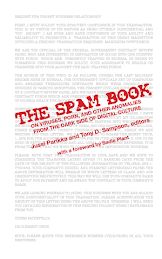
Before leaving finally for ISEA 2010 in Germany I shall post this -- a short intro, or summary, or the extended abstract of what we are going to talk about there with Tony Sampson. It continues the Spam Book themes, and addresses more concretely the link between such processes as contagion (and in relation to heterogeneous bodies from social relations to software) and capitalism -- more specifically marketing techniques, and various ways of harnessing the pull of connectedness.
Learning from Network Dysfunctionality: Accidents, Enterprise and Small Worlds of Infection
Tony D. Sampson (University of East London, UK)
Jussi Parikka (Anglia Ruskin University, UK)
In February 2010 an outbreak of media panic spread through the British tabloid press concerning a marketing campaign called DubitInsider. The DubitInsider website recruits 13-24 year olds who consider themselves to be “peer leader[s] with strong communication skills” to act as “Brand Ambassadors”. This requires the clandestine passing-on of product suggestions to peers via posting on message boards and social networks, emails and instant messenger conversations, organizing small events and parties. DubitInsider ignited the moral indignation of the tabloids not because of its covert nature, but since Brand Ambassadors were apparently paid to market “unhealthy” junk foods to minors. Tapping into the social influence of the consumer is nothing new. Seeking out so-called influentials is the basis of seasoned word-of-mouth campaigns and persists in “word-of-mouse” variations. For example, in4merz.com exploits the anticipated contagiousness of relations established between friends “on and offline” to promote music acts. “In4merz is about matching our artists to your friends who may like them.”
Young In4merz create posters, banners and videos about acts, Twitter about them, leave comments on Facebook etc. For each level of promotion, In4merz earn points that convert into CDs, DVDs, concert tickets and potential backstage access.
What interests us, as analysts of network dysfunctionality, is how the logic of these marketing strategies overlaps with the same anomalous abstract diagrams that distribute spam and viruses. In a different context, hiding unsolicited brand messages in social media and the potential for the bulk sending of veiled product promotions for financial reward could arguably be called spamming.
Furthermore, designed as they are to spread Trojan-like suggestions through imitative social networks, whether or not the strategies actually become contagious, their aim is to go viral. When removed from the context of the anomalous Nigerian cybercafe or computer virus writing scene, and played out in the marketplaces of food and pop culture, the emergent spam logic and virality of network capitalism becomes part of a broader indexical change concerning the way contagious communication networks, vulnerable bodies and unconscious behaviours can be harnessed.
The logic adopted becomes a normalized online marketing activity, not only performed by corporations, but embedded in social relations of individuals as part of the strategies of business enterprise and brand design.
Spamming and virality are no longer anomalies then, but are fast becoming the standard, acceptable way of doing business in the digital world. If the peer-to-peer recommendations and thumbs-up-buttons of “word-of-mouth 2.0” characterize the current paradigm of social media, these campaigns are indicative of a more aggressive and targeted Web 3.0 marketing of suggestion already on the horizon. This is a Web 3.0 that appeals directly to a user’s emotional landscape and desire for intimacy (Ludovico 2005), and exploits the ready made expediency of contagiousness networks that pass on suggestion.
Following a similar neo-monadological approach set out by Lazzarato (2004) we articulate the dynamics of spam, viruses, and other related “anomalies”, as constituent parts of new infectious worlds “created” by the business enterprise. We focus on the specific creative capacities of dysfunctionality in the production of network environments, and how “learning” from the irregularities of normalized communication adds new flesh to this world. We discuss how new knowledge concerning the productive powers of the anomalous is filtered through what Thrift (2005) calls the cultural circuit of capitalism: “… a feedback loop which is intended to keep capitalism surfing along the edge of its own contradictions”.
This new knowledge, acquired from the accidental events of the network, is seized upon by the business enterprise, leading to new consumer modeling intended to make ready environments so that the capricious spreading of social influence can be all the more effectively triggered and responded to.
Zittrain (2009) argues that viruses, spam and worms are threats to the generative principle of the Internet. Similarly, we contend that such software-driven social actions are exploitative of the open principles of the Internet, but further acknowledge the extent to which these practices have enthused and inspired the business enterprise. As we see it, “bad” software is not necessarily “malicious”. It becomes integral to an alternative generative logic of capture implicated in the production of new worlds of infection. We will discuss how these epidemiological worlds were mapped by computer scientists in the 1980s before they pervaded the burgeoning offshoots of the billion dollar network security industry. We further chart how they were modeled by network science as early as the 1960s and are currently being exported, via the circuitry of capitalism, to the business enterprise.
To be published in full as a chapter in The Blackwell Companion to New Media Dynamics, Hartley, Burgess and Bruns (eds.), Wiley-Blackwell, (forthcoming).
Thursday, 12 August 2010
The Creative Technologies Review-podcasts
One of the highlights of my pre-academia career as a freelance journalist when during a phone interview the interviewee, a female at a telecommunications company marketing department or something of approx. 35 years of age, interrupted me: "Oh I am sorry to interrupt the interview but I just have to say you have an amazing telephone voice."
I blush, stutter, and for a second wonder if my future career is somewhere where I could put my voice into better use, such as in some of those dubious 0800-numbers that offer services of very wide variety.
Instead, I end up as an academic.
Despite the shortness of the flirtation with the idea of using my voice to make money, I have been drawn into something again where I need to talk - publicly. The shock horror at first, but then realizing its actually enjoyable despite the fact that there is always a tiny region in your brain that is probably trying to say something very inappropriate.
Anyhow, CoDE-institute and me with Julio D'Escrivan (whose original idea this was) present: the Creative Technologies Review-podcasting series that commenced in August 2010.
We label it as
"A podcast on technology and creativity, technology mostly misused, unintentionally artistic technology and music technology with the odd splattering of digital economies" and hope it to be usually a 30 min aberration into the interminglings of technology, net culture, a slight dash of political economy, academic stuff and lots of media arts.
It features interviews of creatives, techs and academics, and aims to throw a spotlight both on the work done at CoDE institute in Cambridge but also more widely (as in globally) on creative technology and arts. I am suspecting it turns out to be quite focused on sound, knowing Julio's interests and expertise in sound art, sonicity, but it will definitely splash into other fields of expression too and I am sure to throw in a nice dose of media theoretical meditation.
Its hopefully soon available on Itunes, but meanwhile episodes can be downloaded here.
Please get in touch if you have feedback, or suggestions for themes, sites, projects, etc. to be featured!
I blush, stutter, and for a second wonder if my future career is somewhere where I could put my voice into better use, such as in some of those dubious 0800-numbers that offer services of very wide variety.
Instead, I end up as an academic.
Despite the shortness of the flirtation with the idea of using my voice to make money, I have been drawn into something again where I need to talk - publicly. The shock horror at first, but then realizing its actually enjoyable despite the fact that there is always a tiny region in your brain that is probably trying to say something very inappropriate.
Anyhow, CoDE-institute and me with Julio D'Escrivan (whose original idea this was) present: the Creative Technologies Review-podcasting series that commenced in August 2010.
We label it as
"A podcast on technology and creativity, technology mostly misused, unintentionally artistic technology and music technology with the odd splattering of digital economies" and hope it to be usually a 30 min aberration into the interminglings of technology, net culture, a slight dash of political economy, academic stuff and lots of media arts.
It features interviews of creatives, techs and academics, and aims to throw a spotlight both on the work done at CoDE institute in Cambridge but also more widely (as in globally) on creative technology and arts. I am suspecting it turns out to be quite focused on sound, knowing Julio's interests and expertise in sound art, sonicity, but it will definitely splash into other fields of expression too and I am sure to throw in a nice dose of media theoretical meditation.
Its hopefully soon available on Itunes, but meanwhile episodes can be downloaded here.
Please get in touch if you have feedback, or suggestions for themes, sites, projects, etc. to be featured!
Saturday, 17 July 2010
Screen memories to be forgotten

"The brain is the screen", announced Gilles Deleuze some decades ago and summed up - beforehand - a range of things to come. The enthusiasm for the brain whether in terms of screen cultures (a range of films that play with mind, brain, and memory, and what Thomas Elsaesser has called the mind-game genre) or in new kinds of media interfaces e.g. for gaming is paralleled by a range of cultural and media theory looking into the notion of brain as a key metaphor, or node, for understanding contemporary media culture. Far from an earlier enthusiasm for the mind as separated from the body, and as an emblematic figure for the oh-so-much-hated-by-cultural-studies Cartesian worldview, the more recent enthusiasms is as much oriented towards brain as the fleshy epicentre of nerves, and sensation. The brain, too, is fleshy, vitalistic, and full of mattering matter, intensity, and in the world.
This is paradoxically why Christopher Nolan's Inception is such a disappointment. Despite fitting in perfectly with a range of screen culture examples from past years such as his own Memento to Eternal Sunshine of the Spotless Mind, or Doll House , The Matrix, etc., it does not bring anything new to the genre, or an elaborated, innovative, or even exciting take on the centrality of the cognitive for current media culture. To be honest, with a topic like this, can you fail? Memory and the cognitive can be so interestingly be connected to key contemporary processes of cultural production and capitalism, even to an extent that has been branded as cognitive capitalism. Not only knowledge, affects, and such as an endproduct that can be packaged (thanks Edison, thanks copyright laws) and sold as a discrete unit of cultural industries, but the whole process of production that is more akin to an ecology of seemingly immaterial, cognitive, or emotional values that can be harnessed into value-creation and raise important issues concerning the current "creative precariat" is where these themes concerning feelings, memory and the self are debated and become crucial for the political economy.
Without going into too much detail (as I recognize my shortcomings as a film critic...) I would summarize Nolan's attempt as itself a bit pale, a bit short of exciting. Despite the references to Kubrick, which I personally do not understand at all, Nolan's film is exactly not daring sci-fi when it comes to dealing with the brain or the self. The cliched guiding idea of getting caught in a dream at the expense of reality does not become transported into a more powerful and political "don't get stuck in someone else's dream" but only a bit sentimental storyline. The parallels between political/financial power and power over the mind remain very vague, and the attempt to multiply dimensions of reality (or dream) itself a bit boring. Whereas some critics have at least hailed the visuals as stunning (I beg to differ), what is bothering that it seems to be acceptable to recycle such outdated notions of the mind and the brain in supposedly futuristic settings. Metaphors of depth, architecture, and the subconscious remain mostly vague perhaps Freudian allusions, but on a level that is as insightful as I would expect The Sun's summary of psychoanalysis to be.
Indeed, I admit after reading some more positive writings and after discussions that there would have been potential for much more. The theme of "contagious ideas", or more interestingly "emotion contagion" (that is of key scientific interest for social media cultures). The labyrinthine architectural formations in which urban structures, the psyche and various realities intertwine in a Borgesian or Dickian (as in Philip K. Dick) manner are a strong cinematic trope of contemporary digital culture. Writers such as Peter Krapp have pointed out how film itself has acted as "a medium of aberrations of memory" from such avantgarde works as Chris Marker's La Jetée to more recent science-fictions of The Terminator series and even Men in Black, and indeed its interesting to map how hallucinated, and often psychoid realities are being framed increasingly in such settings which do not take multiple realities only as delusional but at the core of power and control.
However, despite for a second trying to be optimistic and positive I have to return to my original feeling about the film; if such supposedly informed publications as the Wired are even asking if Inception is the scifi heavy-weight of the year, I must myself be in the wrong reality now.
Subscribe to:
Posts (Atom)